Japanese text and grammar analysis
Photograph Japanese you want to read, or paste an article. Maho turns the text into a sentence-by-sentence study guide, showing what it means and how its vocabulary and grammar work.
Sign upGo beyond translating a photo
Use textbooks, manga, magazines or signs as reading material. After text recognition, check the Japanese before exploring translations, kana readings, vocabulary and usage explanations. If you already have digital text, paste it directly to skip recognition.
Save unfamiliar vocabulary to your word notebook and keep sentences you want to revisit. When signed in, your analysis history helps you return to the same article and continue reading or review it later.
What can you learn from one Japanese sentence?
Take 新しい本を読みます。, meaning “I read a new book.” A translation alone does not explain how 新しい modifies a noun, or how 読みます relates to the dictionary form 読む.
Try the worked example and exercises for Japanese particles を and で: select a part of the sentence to see its role, then answer two questions.
- 新しい(あたらしい): an い-adjective meaning “new,” modifying 本 here.
- 本(ほん): a noun meaning “book.”
- を: a particle marking the object of the action. The book is what you read, so the sentence uses 本を.
- 読みます(よみます): the polite form of 読む. Ask Maho AI how the verb changes and when to use this form.
Turn your reading into material you can review
Read the original first and try to understand it before checking the translation. Save words you do not yet know, tap the Japanese to hear it, then return to the example to see how the word is used. Ask Maho AI to compare similar grammar or provide another example.
Take clear, complete photos without glare or tiny text. Vertical layouts, handwriting and stylized manga lettering can cause recognition errors, and AI explanations can be wrong. If text was recognized incorrectly, switch to pasted-text mode and analyze a corrected version of the sentence.
Try a Japanese photo and text analysis example
Switch between Photo and Text to explore the study guide. This is a fixed demonstration; open Maho to use your own material.
新しい本を読みます。
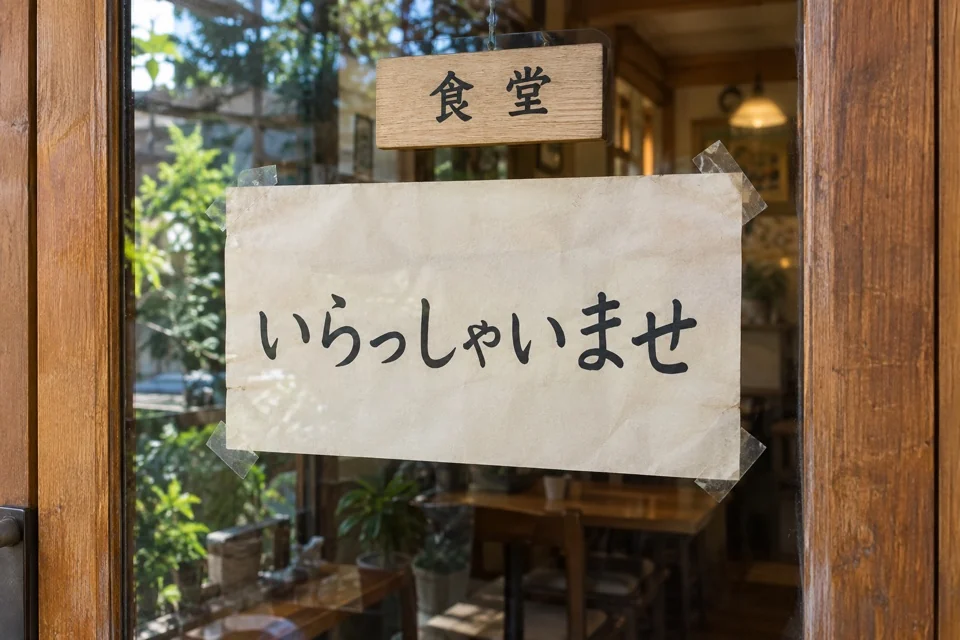
 いらっしゃいませ。
Turn Japanese in a photo into a sentence-by-sentence study guide.
Welcome.
Vocabulary and readingsAn expression derived from the honorific verb 「いらっしゃる」, used to welcome customers to shops and restaurants.
Questions
How is Japanese analysis different from translation?
Translation explains the meaning. Maho also provides readings, vocabulary and grammar explanations so you can understand the structure and save unfamiliar material for review.
Can I analyze a Japanese article?
You can enter an article and examine it sentence by sentence. Start with a short passage to check the original and the explanations before continuing. Recognition and analysis quality depend on the material.
Can I ask follow-up questions?
Yes. Maho AI can use the article, sentence or word you are viewing as context. Ask about a particle, verb form or tone without copying the entire passage again.
How do I correct Japanese text recognized from a photo?
Compare the Japanese text with the photo. Return to the analysis start screen, select pasted-text mode, enter the corrected sentence and start a new analysis. A clearer photo may also help if the text is small, blurred or affected by glare.